
Anselm of Canterbury
Benedictine abbot, philosopher, theologian, Archbishop of Canterbury.

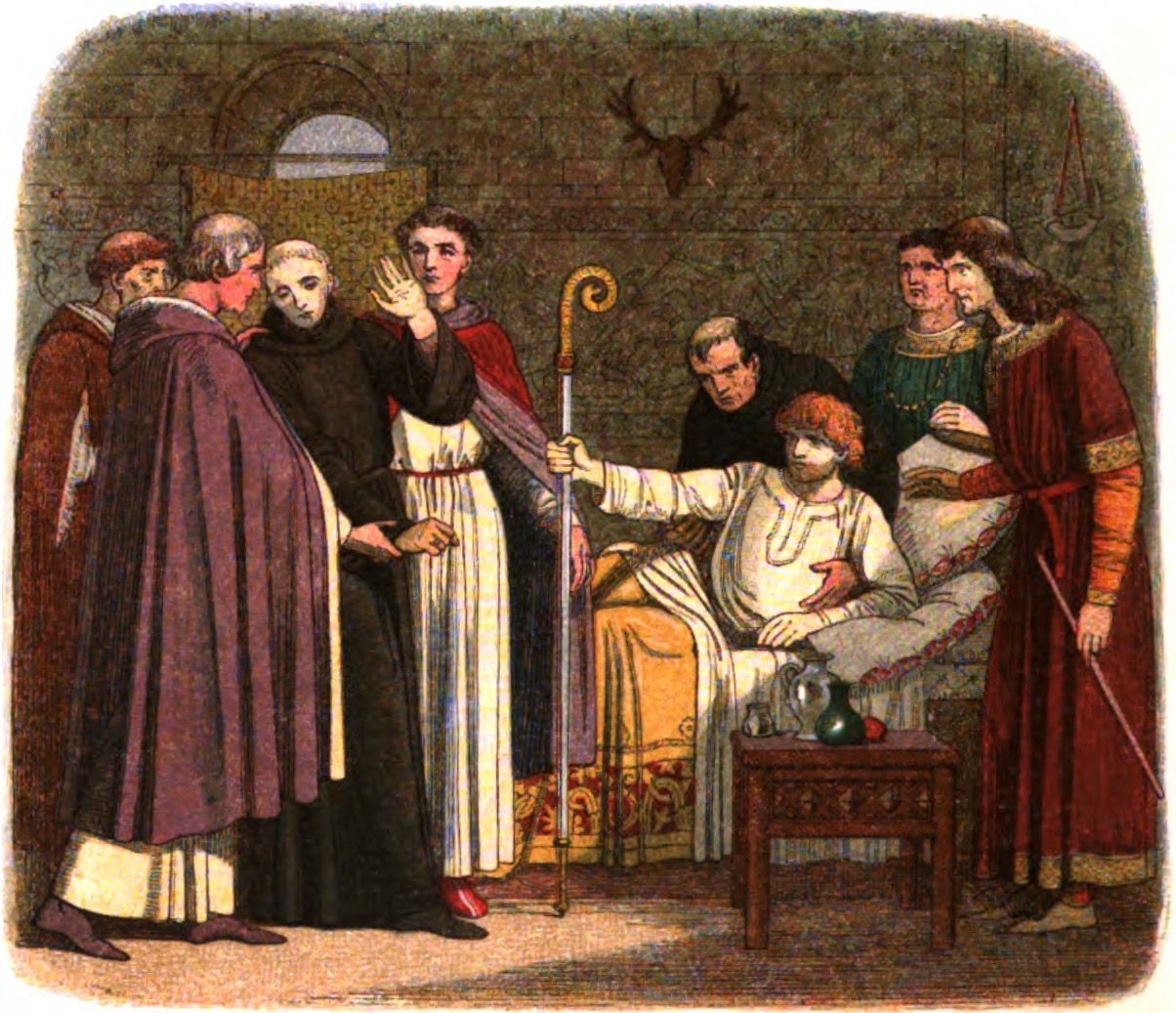
James William Edmund Doyle / Edmund Evans · Public domain
He is remembered for his defense of the Church during the Investiture Controversy, his development of the ontological argument for God's existence, and his satisfaction theory of atonement, which later contributed to his reputation as a founder of Scholasticism.
- field
- Philosophy, theology
- nationality
- Lombard (born in Upper Burgundy, later part of Italy)
- known_for
- Ontological argument for God's existence, satisfaction theory of atonement, defense of Church in Investiture Controversy
Lore & Background
His father Gundulph was a Lombard noble; his mother Ermenberge was devout and managed the family estates. At age 15, Anselm sought to enter a monastery but was refused by his father and the abbot. After his mother's death and his father's entry into a monastery, Anselm left home at 23, crossed the Alps, and wandered for three years. He wrote his first work, the Grammarian, probably in his first year. Under his direction, Bec became a foremost seat of learning. He wrote the Monologion, Proslogion, and dialogues on truth, free will, and the fall of Satan. He also defended Trinitarianism against the nominalist Roscelin. He asserted Canterbury's primacy over York and the Welsh bishops, though Pope Paschal II later reversed this.
Reader's Guide
Anselm of Canterbury is significant for his contributions to medieval philosophy and theology, particularly the ontological argument for God's existence and the satisfaction theory of atonement. His works combined mystical and rational approaches, leading some to credit him as a founder of Scholasticism, though he lacked recognition in this field during his lifetime. As Archbishop, he defended Church interests against royal encroachment during the Investiture Controversy, enduring two exiles. His efforts to assert Canterbury's primacy over York were initially successful but later reversed by Pope Paschal II. His legacy endures in philosophical and theological discourse, particularly through the ontological argument and atonement theory.
Did You Know?
- He participated in the Council of Bari, helping convince Greek Catholic bishops to adopt the Roman Rite.
- His father Gundulph was a Lombard noble, and his mother Ermenberge was probably a granddaughter of Conrad the Peaceful.
The Archbishop's Stand Against the Crown
As Archbishop of Canterbury from 1093 until his death in 1109, Anselm found himself locked in a bitter struggle with the English monarchy over the rights of the Church. The Investiture Controversy placed him directly against both William II and Henry I, and his refusal to yield to royal demands cost him his seat on two separate occasions. His first exile stretched from 1097 to 1100, and a second followed from 1105 to 1107, during which he traveled to the Council of Bari. There he played a key role in persuading the Greek Catholic bishops of southern Italy to embrace the Roman Rite, extending his influence well beyond English shores. Back in England, Anselm pressed the claim that Canterbury held primacy over both the Archbishop of York and the bishops of Wales. By the time he died, this position appeared to be firmly established. Yet the matter was not settled in his favor: Pope Paschal II subsequently overturned the papal decisions and restored York to its earlier standing, undoing what Anselm had achieved in his final years.
Father of Scholastic Thought and the Ontological Argument
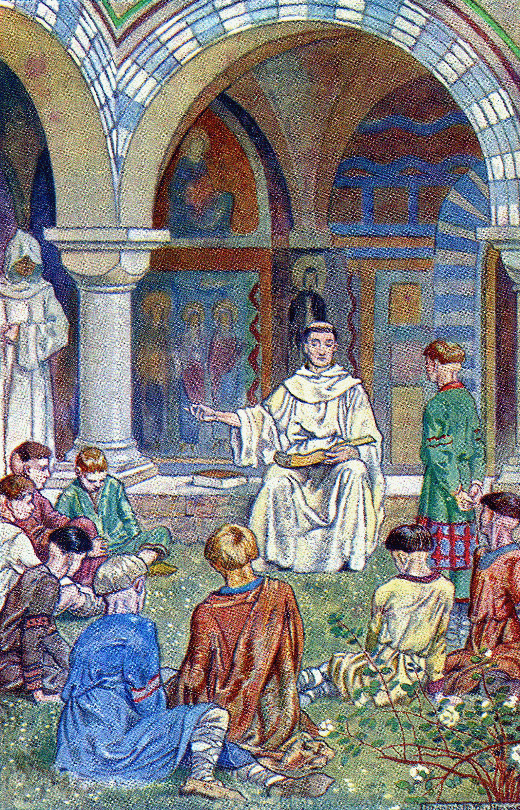
During his years at the Benedictine abbey of Bec, Anselm began composing dialogues and treatises that blended mystical devotion with rigorous philosophical reasoning. This dual approach led later scholars to credit him as a founding figure of Scholasticism, a designation he never enjoyed in his own lifetime. His most celebrated intellectual contributions include the ontological argument for the existence of God and the satisfaction theory of atonement, both of which he is famously regarded as having originated. His earliest known work, a treatment of Latin paradoxes called the Grammarian, was likely written during his first year at Bec, suggesting that his philosophical mind was already active before the Rule of Saint Benedict fully reshaped his thinking over the following decade. Despite the enduring fame of his arguments, Anselm's recognition as a systematic philosopher came only after his death, and his legacy in this field rests on a body of work that married contemplative faith with logical inquiry in a way that would influence centuries of Western thought.
From Aosta to Bec: A Young Man's Search
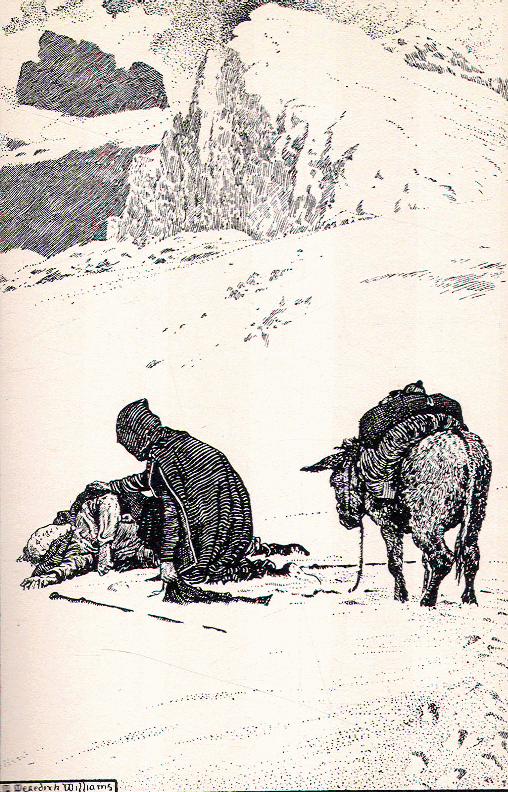
Born in or around Aosta in Upper Burgundy between April 1033 and April 1034, Anselm grew up in a household shaped by political upheaval and conflicting temperaments. His father, a Lombard noble named Gundulph, was known for being overgenerous and careless with the family's wealth, while his mother Ermenberge, a patient and devout woman, managed the estates with prudence. At fifteen, Anselm felt a powerful call to monastic life but was turned away by the abbot because his father would not consent. The disappointment reportedly triggered an illness, and he drifted into a carefree existence. After his mother's death and his father's subsequent conversion to a severity the young man found equally unbearable, Anselm finally left home at twenty-three with a single attendant. He crossed the Alps and wandered through Burgundy and France for three years before reaching Normandy in 1059, drawn by the reputation of Lanfranc, prior of Bec. After his father's death, Lanfranc directed him to Archbishop Maurilius of Rouen, who persuaded him to enter Bec as a novice at the age of twenty-seven.
Saint, Doctor, and Enduring Influence
Anselm's posthumous recognition grew steadily over the centuries following his death in 1109. He was canonized as a saint, and the Church commemorates him each year on 21 April. In 1720, Pope Clement XI elevated him further by proclaiming him a Doctor of the Church through a papal bull, a distinction reserved for figures whose theological and philosophical contributions are held in the highest regard. Throughout his life he was known by several names reflecting his origins and affiliations: Anselm of Aosta after his birthplace in what is now the Republic of Italy, and Anselm of Bec after the Norman monastery that shaped his intellectual development. His identity as a Benedictine abbot, philosopher, and theologian who served as Archbishop of Canterbury for sixteen years made him a figure of extraordinary range. Yet it was his written works—dialogues and treatises that wove together mystical contemplation and rational argument—that secured his place in the Western intellectual tradition, ensuring that his voice would continue to resonate long after the political disputes of his archiepiscopate faded from memory.
Gallery
Frequently Asked Questions
What is Anselm's ontological argument for God's existence?
It is a purely conceptual proof that starts from the idea of 'that than which nothing greater can be conceived' and argues that such a being must exist in reality, not just in the mind, because existence in reality is greater than existence merely in thought. Anselm first presented this line of reasoning in his work *Proslogion*.
What role did Anselm play in the Investiture Controversy?
He sided with the papacy against secular monarchs who insisted on the right to appoint bishops and abbots, insisting that the Church must retain independent authority over its own leadership. His firm stance brought him into open conflict with the English crown and ultimately led to his exile from Canterbury.
What is Anselm's satisfaction theory of atonement?
Anselm argued in *Cur Deus Homo* that human sin incurred an infinite obligation toward God that no mere human could discharge, so the debt could only be satisfied by one who was simultaneously fully divine and fully human—Christ. This framework became one of the most influential explanations of why Christ's death matters in Christian theology.
Why is Anselm often called a founder of Scholasticism?
His method of applying strict logical analysis to core theological questions, especially in works like *Monologion* and *Proslogion*, established a model that later medieval scholars expanded into the full Scholastic tradition. He effectively demonstrated that faith and rigorous philosophical reasoning could work together, setting the intellectual agenda for centuries of academic theology.
More in Philosophers And Thinkers 1-24
Elsewhere in the Philosophers And Thinkers universe
Spotted an error? Know more?
This is a living reference — every entry is fact-audited, and reader corrections feed straight into our audit queue. Suggest an edit · See this site's audit record